Automated Welding Systems: A Buyer’s Selection Guide
News Details
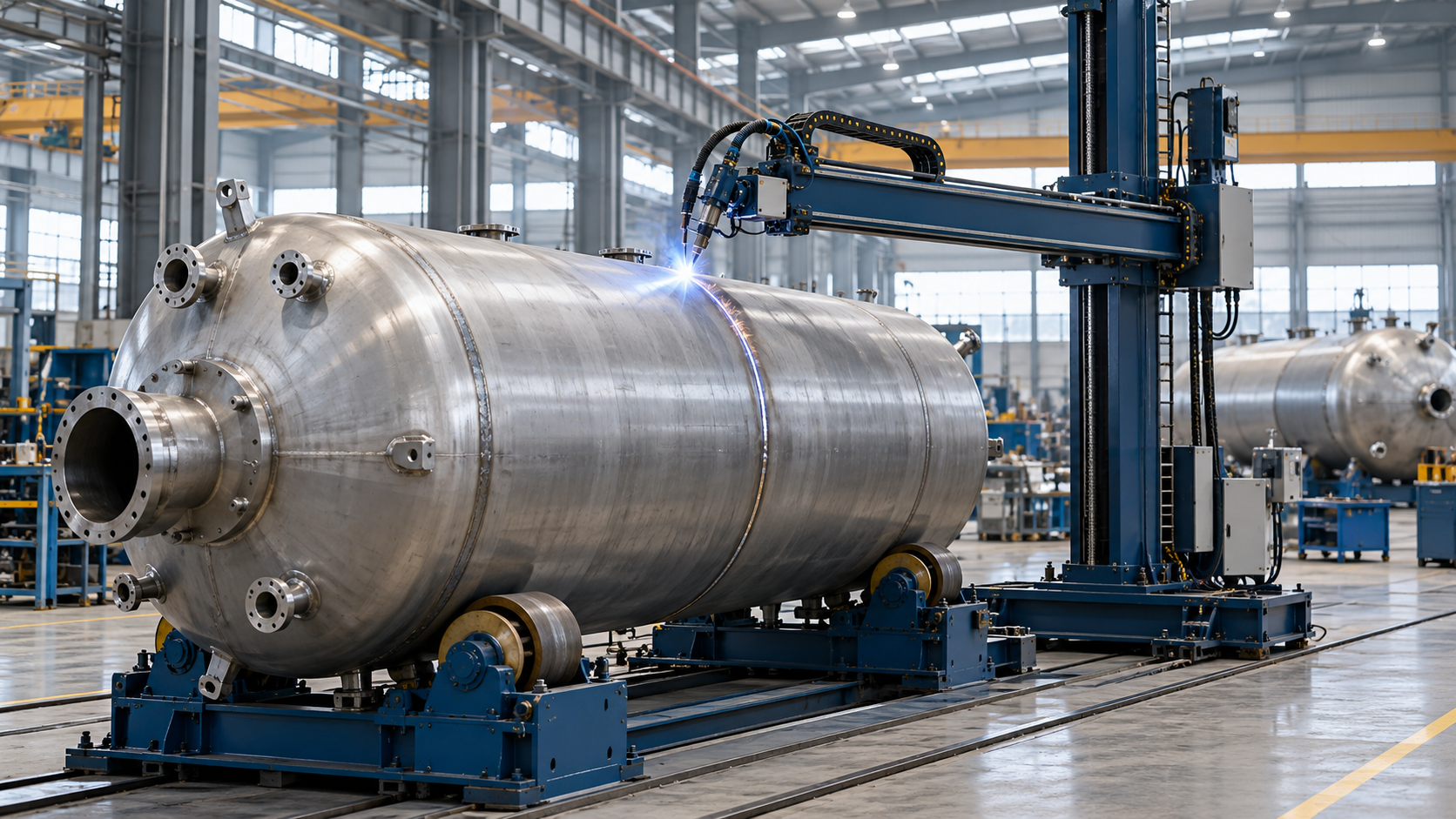
Choosing an automated welding system starts with the workpiece. Its material, shape, joint design and production volume determine which equipment can deliver useful results.
For manufacturers of tanks, pressure vessels, pipes and metal assemblies, automation can make welding motion more consistent. However, a faster welding speed alone does not guarantee higher output. Loading, fit-up, inspection and rework also affect the result.
This guide explains how automatic welding equipment works and what buyers should check before investing.
What Is an Automated Welding System?
An automated welding system combines a welding process with controlled movement and workpiece support. Depending on the application, it may include:
- A welding power source and torch.
- Wire feeding and shielding gas equipment.
- A welding carriage, manipulator or robot.
- Clamps, turning rolls or positioners.
- Controls and optional sensors.
The equipment moves the torch, the workpiece or both along a planned weld path. Meanwhile, the controls manage settings such as travel speed and welding current.
Automation does not always require a robot. A dedicated machine can suit a straight seam, while a manipulator and turning rolls can support circumferential welding.
Start with Material, Joint and Workpiece Data
Before contacting a welding automation supplier, prepare a clear description of the parts.
Specify the material grade, thickness range, overall dimensions and weight. Then identify the joint type, weld position and required weld length.
Fit-up matters just as much. Automation follows a controlled path, so changes in joint gap or alignment can affect weld quality. Sensors may help with some variation, but they cannot correct every assembly problem.
Also, provide drawings and representative samples. These allow the supplier to assess torch access, clamping and process options before proposing equipment.
Match Automatic Welding Equipment to the Seam
Different weld paths need different motion systems.
| Workpiece or seam | Equipment to assess | Main buying checks |
| Flat plate butt joint | Plate butt seam welder | Clamping, backing and effective weld length |
| Cylinder longitudinal seam | Fixed or lifting-type seam welder | Diameter, loading access and support |
| Large vessel longitudinal or circumferential seam | Welding manipulator with suitable auxiliary equipment | Reach, rotation and coordinated movement |
| Half-pipe jacket on a vessel | Dedicated half-pipe welding system | Curved path, torch access and wire feeding |
Juchuang’s product range includes JPB plate butt welding machines, fixed and lifting-type longitudinal seam welders, JBL/BL side-beam systems, JCJS/JSL welding manipulators and a twin-torch half-pipe welding system. These address distinct fabrication tasks rather than one universal application.
Choose the Welding Process Before Comparing Speed
The welding process must suit the material, joint and acceptance requirements.
TIG welding, also called GTAW, offers controlled arc welding and can suit applications with demanding appearance or process needs. However, its output depends on the joint and filler requirements.
MIG/MAG welding uses a continuously fed consumable wire. It can suit many production tasks, although shielding gas, wire selection and transfer mode require careful matching.
Plasma arc welding, or PAW, uses a constricted arc. Its suitability depends on the material, joint preparation and operating conditions.
Some systems combine processes. For example, Juchuang describes Plasma + TIG technology on its fixed longitudinal seam welding machine. Buyers should validate the proposed setup with their own material and joint samples.
Measure the Full Production Cycle
Ask how many acceptable parts the system can produce per shift.
The full cycle includes loading, alignment, clamping, welding, unloading and inspection. Therefore, compare total cycle time rather than torch travel speed alone.
For example, a faster welding process may provide limited benefit if loading takes most of the cycle. Likewise, frequent product changes can reduce useful operating time.
Give the supplier your batch sizes and product mix. Then request a cycle estimate that shows its assumptions, including operator tasks and changeover time.
Check Fixtures, Controls and Upgrade Options
Fixtures hold the joint in a repeatable position. Poor support can cause movement or distortion, even when the welding machine runs consistently.
Review locating points, clamp access and how the finished part will be removed. Also, confirm that the fixture accommodates the expected size range.
Next, assess the controls. Useful questions include:
- Can operators save and recall approved settings?
- How are program changes controlled?
- Can the system connect to the planned power source and auxiliary equipment?
- Are tracking or data-recording options available for this configuration?
Request a demonstration of required features. A general statement about “smart welding” does not define what the supplied system will do.
Evaluate the Welding Automation Supplier
A useful supplier proposal should explain the equipment layout, process choice, scope of supply and technical limits.
Before placing an order, agree on representative trial parts and acceptance criteria. These may cover weld appearance, dimensions, applicable inspection results and production cycle time.
Also, confirm installation needs, training, consumables, spare parts and service arrangements. For overseas delivery, check electrical supply, gas requirements, floor space and lifting access early.
Discuss Your Welding Project with Juchuang
Juchuang’s JCJS/JSL welding manipulators support integration with turning rolls, positioners and other auxiliary equipment for vessel and pipe fabrication. Its twin-torch half-pipe welding system addresses circumferential and helical half-pipe applications.
To begin a selection review, send Juchuang your drawings, material grades, thickness range, joint details, production targets and inspection requirements. A clear specification helps turn an equipment inquiry into a practical welding proposal.


