Plasma vs Gas Nitriding: Distortion & Case Depth
News Details
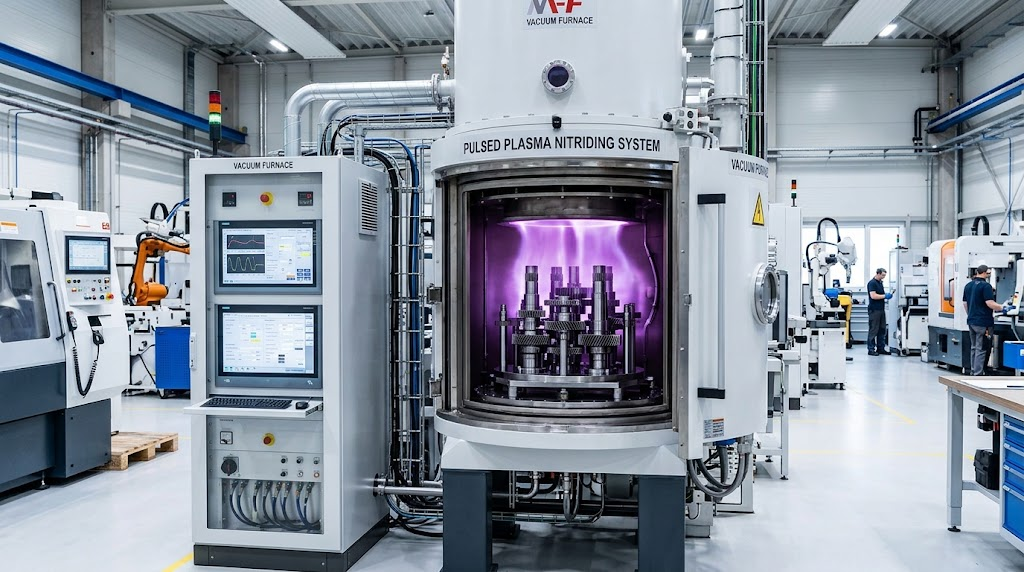
When you design and manufacture industrial components exposed to heavy wear, choosing the right surface treatment is essential. You need a hard outer layer that withstands severe friction, heavy loads, and mechanical wear over time. However, you also must preserve the exact size and shape of your metal parts. If a finished component twists, warps, or expands during heat treatment, it will not fit correctly into your final assembly.
Engineers often compare plasma nitriding vs gas nitriding to determine the most efficient and reliable surface hardening process for their production operations. Both of these established techniques infuse nitrogen into the outer surface of steel to form a hard, wear-resistant compound layer. Yet, they rely on completely different physical mechanisms. These fundamental differences directly affect how the material responds, how much the component bends under high thermal stress, and how deeply the protective nitrogen diffuses.

How the Two Nitriding Processes Work
Before selecting a surface hardening method, it helps to examine how each system operates inside the processing chamber.
Gas nitriding is a traditional, time-tested method. Technicians place clean metal parts into a sealed furnace chamber filled with ammonia gas. As the furnace heats, the high temperature causes the ammonia molecules to split into nitrogen and hydrogen. Free nitrogen atoms are then absorbed gradually into the heated steel surface, forming a hardened layer over several hours.
In contrast, modern industrial operations often prefer pulsed plasma nitriding. This process occurs inside a specialized vacuum chamber. Instead of relying only on heat and gas pressure, it utilizes strong electrical energy and direct ion bombardment. An intense electrical voltage generates a glowing, high-energy plasma field around the components. Reactive nitrogen ions strike the metal surface, remove oxides, and diffuse deeply into the steel matrix. This advanced technology gives operators precise control over each stage of the thermal process.
Comparing Distortion and Dimensional Stability
One of the greatest challenges in modern precision manufacturing is component distortion. When metal parts undergo high temperatures and slow cooling cycles, internal structural stresses often cause them to twist, bend, or expand.
Conventional gas nitriding requires high furnace temperatures for extended periods. Since the entire chamber remains uniformly hot, sensitive or complex parts can deform significantly. As a result, manufacturers must perform additional grinding, honing, or secondary machining after treatment to restore original tolerances. This extra labor increases overall production costs and extends lead times.
On the other hand, pulsed plasma nitriding operates at much lower temperatures. Since the ion bombardment drives nitrogen into the metal through kinetic energy, the bulk of the part experiences significantly less thermal stress. This means you achieve excellent dimensional stability with virtually no measurable distortion. Because the components retain their original geometry, your assembly team can install them immediately without additional post-processing.
Controlling Nitriding Case Depth and Microstructure
Creating a consistent hardness layer is critical for extending the service life of heavy-duty parts. Nitriding case depth determines how well a gear, shaft, or mold endures constant loading and surface contact during everyday use.
With gas nitriding, controlling the exact depth of the hardened layer across complex geometries can be challenging. The chemical reaction depends heavily on uniform gas flow within the furnace. If gas circulation is uneven, or if parts are closely stacked, some areas may develop a shallower case depth than others. Additionally, gas nitriding often creates a thick, brittle outer layer known as a white layer. This fragile surface can crack, chip, or flake under high pressure.
By comparison, plasma systems allow operators to adjust gas mixtures and pulse parameters with exceptional precision. This fine control enables you to set the exact nitriding case depth required for your specific application. Furthermore, you can minimize or completely eliminate the brittle white layer. As a result, you achieve a uniform, tough diffusion layer across complex contours, deep blind holes, and sharp edges.
Effect on Part Fit and Assembly Efficiency
When parts maintain their intended dimensions, they fit into machinery smoothly without force or modification. High dimensional accuracy directly improves part compatibility and reduces overall assembly costs. If you use traditional gas nitriding and your precision gears or hydraulic valves deform, you will waste valuable labor hours reworking them.
In contrast, components processed with advanced plasma systems retain their tight tolerances and sharp surface details. Additionally, plasma treatment produces an exceptionally clean, smooth finish that requires no chemical cleaning or heavy polishing. By choosing a low-stress surface treatment, your metal parts will deliver longer durability, superior load-bearing capacity, and perfect fit immediately upon removal from the vacuum chamber.
Conclusion
Choosing between these two hardening methods depends on your tolerance requirements and the complexity of your parts. While gas nitriding remains a suitable option for simple shapes and low-tolerance components, pulsed plasma nitriding is the superior choice when you need precise control over nitriding case depth and minimal dimensional change. By keeping parts cooler and structurally stable, plasma technology ensures your critical industrial components fit together perfectly every time.


