How to Calculate Welding Automation ROI During a Welder Shortage
News Details
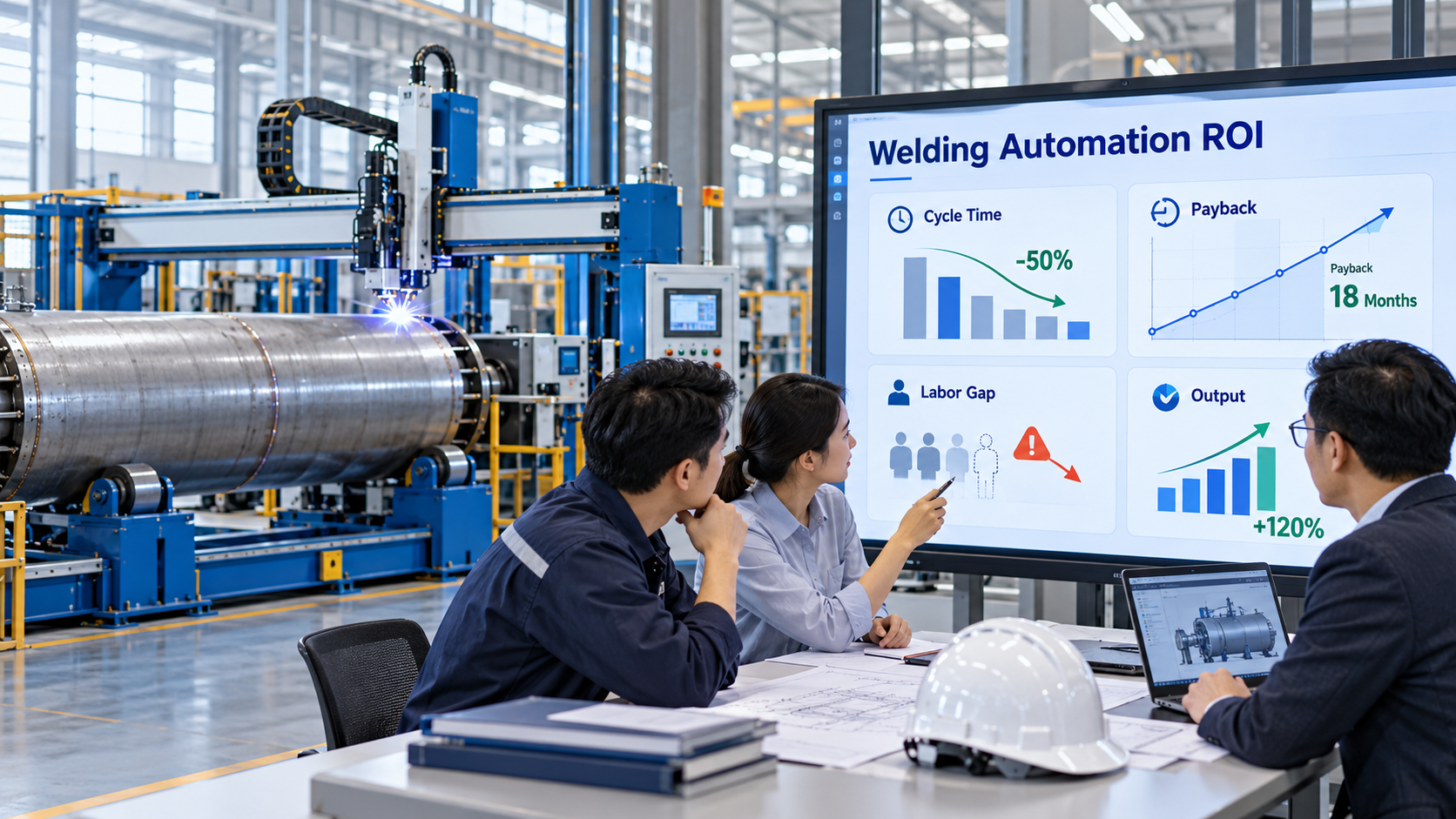
Many factories are facing the same problem: skilled welders are hard to find, and labor costs keep rising. At the same time, customers still expect stable quality, faster delivery, and clear production records.
Because of this, more companies are looking at welding automation. However, before buying a system, managers often ask one key question: how long will it take to pay back?
Welding automation ROI is not only about replacing labor. It also includes faster output, better weld quality, less rework, lower scrap, and more stable production. For companies dealing with a skilled welder shortage automation can be a practical way to protect capacity and reduce risk.
Juchuang provides customized welding automation equipmentfor pressure vessels, tanks, pipes, cylindrical workpieces, and heavy industrial parts. Its solutions include longitudinal seam welding machines, side beam welding systems, welding manipulators, and other automatic welding systems for real production needs.
What Welding Automation ROI Means
ROI means return on investment. In simple terms, it compares the money saved or earned by the automation system with the cost of buying and using it.
For welding automation, ROI often comes from several areas:
- Lower direct labor cost
- Faster welding cycle time
- Higher daily output
- Less rework and scrap
- Better use of skilled welders
- More stable weld quality
- Less downtime caused by labor gaps
- Better delivery performance
Therefore, a fair ROI calculation should look at the full production value, not only the machine price.
Step 1: Start With Current Welding Cost
First, measure the current manual welding cost. This gives you a baseline.
Useful data includes:
- Number of welders per shift
- Hourly wage and benefits
- Number of shifts per day
- Welded parts per shift
- Rework rate
- Scrap rate
- Overtime hours
- Training cost
- Cost of delayed orders
For example, if two welders are needed for one seam welding process, the yearly labor cost may be much higher than the visible hourly wage. Benefits, overtime, training, and turnover should also be included.
Also, during a welder shortage, the hidden cost can be large. If orders are delayed because there are not enough skilled welders, the factory may lose sales or customer trust.
Step 2: Measure Welding Cycle Time
Welding cycle time is one of the most important numbers in the ROI calculation. It shows how long it takes to complete one welding task.
For manual welding, include:
- Part loading
- Positioning
- Tack checking
- Welding time
- Cleaning
- Inspection
- Rework time, if needed
For automatic welding, include:
- Loading and clamping
- Program selection
- Automatic welding
- Unloading
- Inspection
- Changeover time
Then compare the total time per part. Automation may reduce arc time, but it can also reduce idle time and rework. As a result, the true gain may be larger than it first appears.
Step 3: Estimate Output Improvement
Once cycle time is clear, calculate output.
A simple formula is:
Daily output = Available production time ÷ Welding cycle time
For example, if one part takes 30 minutes manually, one station can produce about 16 parts in an 8-hour shift. If automation reduces the time to 15 minutes, output can rise to about 32 parts per shift.
However, use real numbers. Include loading, handling, and inspection time. A practical ROI plan should be based on stable production, not the fastest single test.
Step 4: Add Quality Savings
Weld quality has a direct cost. Poor welds may lead to grinding, repair welding, extra inspection, delayed shipment, or rejected products.
Automation can help because it controls torch movement, travel speed, current, voltage, wire feed, and weld path. This improves repeatability, especially for long seams and circular welds.
Quality savings may include:
- Lower rework labor
- Less filler wire and gas waste
- Fewer rejected parts
- Lower inspection failure rate
- Less customer complaint cost
- More stable weld appearance
For tanks, pressure vessels, pipes, and cylinders, consistent weld quality can also reduce risk in later pressure testing or leak testing.
Step 5: Count Better Use of Skilled Welders
Automation does not always mean removing people. Often, it means using skilled welders in a better way.
Instead of doing every weld by hand, experienced welders can set parameters, check fit-up, monitor production, and solve process issues. One skilled operator may manage one or more welding stations, depending on the system design.
This is important during a skilled welder shortage. The factory can keep expert knowledge in the process while reducing dependence on hard-to-find manual labor.
Step 6: Include Total Investment Cost
Next, calculate the total cost of the automation project.
This may include:
- Welding machine or system
- Fixtures and tooling
- Welding power source
- Safety devices
- Installation
- Operator training
- Spare parts
- Maintenance
- Factory utilities
- Process testing
A custom system may cost more at the start, but it may fit the product better and deliver stronger long-term value. For this reason, the machine should be designed around the actual workpiece, not only around a general equipment model.
Step 7: Calculate Payback Period
A simple payback formula is:
Payback period = Total investment ÷ Yearly net savings
For example, if the total investment is 120,000 USD and yearly net savings are 60,000 USD, the payback period is 2 years.
Yearly net savings can include labor savings, output gains, quality savings, and reduced overtime. Then subtract added costs such as maintenance, power, and consumables.
This gives a clearer view of the real welding automation ROI.
Why Work With Juchuang
Juchuang focuses on customized welding automation for industrial manufacturing. Its equipment supports pressure vessels, tanks, pipes, longitudinal seams, circumferential seams, and cylindrical workpieces.
Because every factory has different products and labor needs, Juchuang can help review the welding process, estimate welding cycle time, design fixtures, integrate welding systems, run sample tests, and support installation. This helps customers build an automation plan that fits both production goals and budget.
Conclusion
A welder shortage can limit growth, delay orders, and increase production risk. Welding automation can help, but the investment should be calculated with clear numbers.
To estimate welding automation ROI, start with current labor cost, welding cycle time, output, quality loss, and total project cost. Then compare those numbers with the expected automated process.
With the right system design, welding automation can reduce dependence on scarce labor, improve weld consistency, and give factories a stronger path for long-term production.


