Longitudinal vs Circumferential Seam Welding Systems for Vessels and Tanks
News Details
Making heavy pressure vessels, storage tanks, and industrial pipes requires strong, defect-free welds. During tank fabrication, two main joints hold the structure together: longitudinal seams and circumferential seams. Because these two joints face different physical stresses and alignment needs, choosing the right automated equipment is essential for shop efficiency and product safety.
Understanding the differences between a longitudinal seam welding machine and a circumferential seam welding machine helps factory managers build smooth, automated production lines. In this guide, we break down how both systems operate and how integrating them creates a complete vessel fabrication workflow.
What Is Longitudinal Seam Welding?
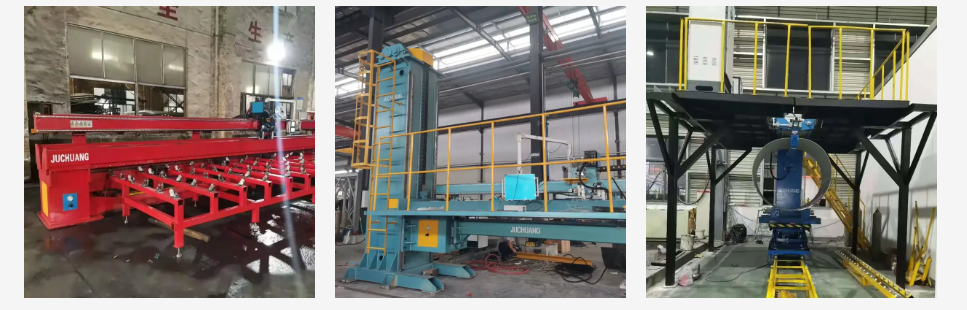
Longitudinal seam welding joins the flat edges of a rolled metal sheet to form a cylinder or shell. This straight seam runs parallel to the center axis of the tank or pipe.
Key Operational Features
-
Flat-Bed Alignment: The rolled metal sheet rests flat on a specialized clamping bed. Copper backing bars and pneumatic fingers hold the metal edges tight to prevent heat warping.
-
Linear Torch Movement: A precise motor moves the welding torch in a straight line along the seam while the tank shell remains stationary.
-
Internal and External Passes: Depending on wall thickness, operators weld the inner seam, outer seam, or both to achieve full penetration.
Primary Challenges
Longitudinal seams take the highest hoop stress when a vessel holds pressure inside. Therefore, precise edge alignment, uniform heat control, and zero burn-through are critical. A dedicated longitudinal seam welding machine delivers exact travel speeds and steady arc lengths to prevent structural flaws.
What Is Circumferential Seam Welding?
Circumferential seam welding—often called girth or round seam welding—joins two cylindrical shells together end-to-end, or attaches domed tank heads to a rolled body. This circular weld wraps entirely around the circumference of the vessel.
Key Operational Features
-
Stationary Torch Position: Unlike straight seam welding, the torch remains fixed in one position overhead or on a heavy column and boom.
-
Workpiece Rotation: The vessel rests on motor-driven turning rolls or a tilt positioner that rotates the tank at a steady speed.
-
Multi-Pass Welding: Thicker pressure vessel walls require several continuous passes, such as root, fill, and cap passes, using Submerged Arc Welding (SAW) or Gas Metal Arc Welding (GMAW).
Primary Challenges
Maintaining constant surface speed during rotation is vital. If rotation speed changes or the vessel drifts on the rollers, the weld bead becomes uneven. Modern circumferential systems use anti-drift turning rolls and laser tracking to keep the torch centered on the seam.
Comparing Longitudinal and Circumferential Welding Systems
To choose the right machinery for your shop layout, review these key operational differences:
| Feature | Longitudinal Seam Welding | Circumferential Seam Welding |
| Seam Direction | Straight line along the cylinder length | 360-degree circle around the tank diameter |
| Motion Strategy | Torch moves along a fixed rail | Tank rotates under a fixed torch |
| Key Support Hardware | Clamping mandrels & copper backing bars | Turning rolls, rotators & column/boom units |
| Primary Stress Type | High internal hoop stress | Axial and bending stress |
Key Factors When Choosing Seam Welding Machinery
When upgrading your shop floor, keep these core parameters in mind:
-
Material Type & Thickness: Stainless steel, carbon steel, and aluminum behave differently under heat. Thicker plates require high-current Submerged Arc Welding (SAW) or multi-pass Gas Metal Arc Welding (GMAW), while thin sheets suit TIG or Plasma arc setups.
-
Production Volume: High-volume tank lines benefit from fully automatic loading systems, quick-clamping fixtures, and dual-torch setups to cut cycle times.
-
Part Dimensions: Match the beam length on your longitudinal seamer to your longest shell section. Similarly, ensure your turning rolls handle the total weight and diameter range of your largest vessel.
Integrating Both Systems for Full Line Automation
A complete longitudinal and circumferential welding system brings both processes into a single automated workflow. Rather than moving heavy tank shells manually between stations, an integrated system uses synchronized rollers, transfer cars, and central PLC controls.
Integrating your seam welding equipment offers clear benefits:
-
Higher Output: Automated clamping and motorized rotation eliminate manual setup delays.
-
Consistent Quality: Uniform travel speeds ensure clean X-ray pass rates and minimize rework.
-
Improved Workplace Safety: Heavy lifting mechanisms handle large shells safely, reducing manual labor risks for shop operators.
Partner with Juchuang for Custom Welding Solutions
Setting up a high-volume tank production line requires specialized machinery tailored to your shell diameters, material thicknesses, and factory layout. Off-the-shelf equipment often fails to handle complex vessel shapes efficiently.
As an experienced custom welding machine manufacturer and leading welding system integrator China, Juchuang designs and builds complete automated welding setups. From high-precision longitudinal seamers to heavy-duty circumferential rotators and seam-tracking systems, Juchuang helps industrial manufacturers streamline tank production and improve weld quality.
Contact Juchuang today to consult with our engineering team and discover the right welding system for your tank and vessel manufacturing line.


