Side-Beam Welding Systems: When Compact Access Matters
News Details
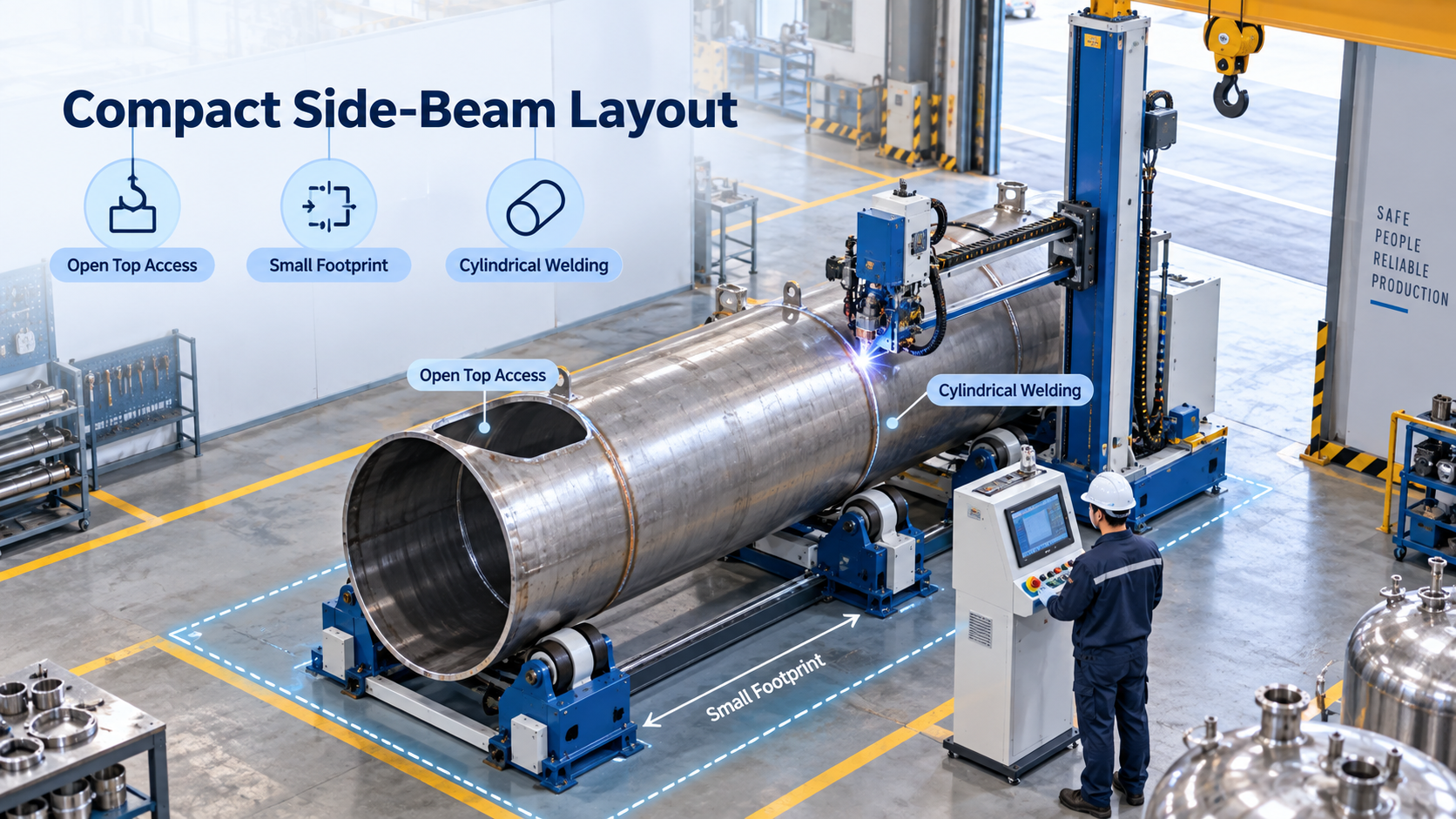
In many metal workshops, space is always under pressure. Large tanks, pipes, vessels, and cylinders need stable welding, but the floor may not allow a full gantry, long column boom, or large handling system. In this case, a side beam welding machine can be a smart choice.
A side-beam welding system places the welding carriage and torch on a side-mounted beam. The workpiece can be supported by rollers, a rotary table, or a fixture. As a result, the machine can handle cylindrical workpiece welding while keeping the layout compact and easy to access.
Juchuang designs automated welding systems for pressure vessels, tanks, pipes, stainless steel products, and other industrial parts. For factories that need stable welds in a smaller space, side-beam equipment offers a useful balance of access, control, and cost.
What Is a Side-Beam Welding System?
A side-beam welding system is an automatic welding setup with a horizontal beam placed beside the workpiece. The welding head moves along the beam, while the part is turned or positioned by a support system.
The system can be used for longitudinal seams, circumferential seams, or similar weld paths on round and semi-round parts. Depending on the process, it may support a MIG MAG welding system, PAW welding, TIG welding, or other welding methods.
In simple terms, the beam guides the welding torch. The fixture or roller system controls the workpiece. Together, they help the weld stay even from start to finish.
Why Compact Access Is Important
Not every factory has a large welding bay. Some plants must fit welding, lifting, inspection, and material flow into a tight area. Also, many cylindrical parts are heavy, so easy crane access is important.
A side-beam structure can help because the workpiece is open from the top. This makes loading and unloading easier. It also gives operators better access for tack welding, checking fit-up, and cleaning the weld area.
In addition, the machine can often work with existing roller frames or support tools. Therefore, it may reduce the need for a very large custom handling system.
Where Side-Beam Welding Works Best
Side-beam systems are often used in industries that weld round or curved metal parts. Common applications include:
- Stainless steel pipes
- Small and medium pressure vessels
- Storage tanks
- Cylindrical shells
- Filter housings
- Heat exchanger parts
- Thin-wall and medium-wall tubes
- Circular or longitudinal seams
For cylindrical workpiece welding, the key need is stable rotation and steady torch travel. If the part can be held and rotated smoothly, the side beam can provide a reliable weld path.
However, each project should be checked based on part size, wall thickness, material, weld length, and production volume. This is why custom design is often needed.
Benefits of a Side Beam Welding Machine
A side beam welding machine offers several practical benefits for production teams.
First, it saves floor space. The structure is more compact than many large column-and-boom systems. This makes it useful for workshops with limited room.
Second, it improves access. Operators can load the part from above or from the side, depending on the layout. This can shorten handling time and make daily work easier.
Third, it supports stable welding. With the right beam, carriage, torch holder, and control system, the torch can move smoothly along the seam. This helps reduce uneven welds caused by manual hand movement.
Fourth, it is flexible. The system can be matched with different welding power sources, tracking devices, rollers, or fixtures. As a result, one system may support several similar parts.
MIG MAG Welding System Integration
Many factories choose a MIG MAG welding system for side-beam equipment because it is fast, practical, and widely used. It can be suitable for carbon steel, stainless steel, and other metals, depending on wire, gas, and welding procedure.
When integrated into a side-beam system, MIG/MAG welding can help improve output and reduce operator fatigue. The operator still prepares the part and monitors the process, but the machine controls torch travel more consistently.
Important integration points include:
- Welding power source selection
- Wire feeding stability
- Torch angle adjustment
- Gas protection
- Seam tracking
- Travel speed control
- Start and stop crater control
- Spatter management
Moreover, the system should allow easy parameter adjustment. This helps teams tune current, voltage, wire feed speed, and travel speed for different parts.
Key Design Points Before Buying
Before choosing a side-beam welding system, buyers should define the main production needs. A clear plan helps avoid oversizing, undersizing, or missing key functions.
Useful questions include:
- What is the minimum and maximum workpiece diameter?
- What is the maximum workpiece length and weight?
- Is the weld longitudinal, circular, or both?
- What material and wall thickness will be welded?
- Which welding process is required?
- Is seam tracking needed?
- Will the system connect to existing rollers or fixtures?
- How much space is available for loading?
- What level of data recording is needed?
After these points are clear, the supplier can design the beam length, carriage stroke, torch adjustment range, control system, and safety layout.
Quality and Repeatability
Automation is not only about speed. It is also about repeatable weld quality. A well-designed side-beam system helps keep the torch position, travel speed, and welding angle stable.
Still, the final result also depends on part fit-up, surface cleaning, welding procedure, and operator training. Therefore, the machine should be tested with real sample parts before delivery.
For critical products such as pressure vessels or sealed tanks, weld inspection may include visual checks, leak testing, penetration testing, or other tests based on the project standard.
Why Work With Juchuang
Juchuang provides customized welding automation equipment for industrial production. Its product range includes welding manipulators, longitudinal seam welding machines, side beam welding systems, and other automatic welding solutions for vessels, tanks, pipes, and metal structures.
For side-beam projects, Juchuang can support process review, fixture design, machine building, welding process integration, testing, installation, and training. This helps customers build a system that fits both the workpiece and the workshop.
Conclusion
When compact access matters, a side-beam welding system can be a practical solution. It saves space, improves loading access, and supports stable welding for round and cylindrical parts.
For factories that need a MIG MAG welding system for cylindrical workpiece welding, a side beam welding machine can improve consistency while keeping the production layout simple and efficient.


