Automatic Welding FAT/SAT Checklist for Stable Production
News Details
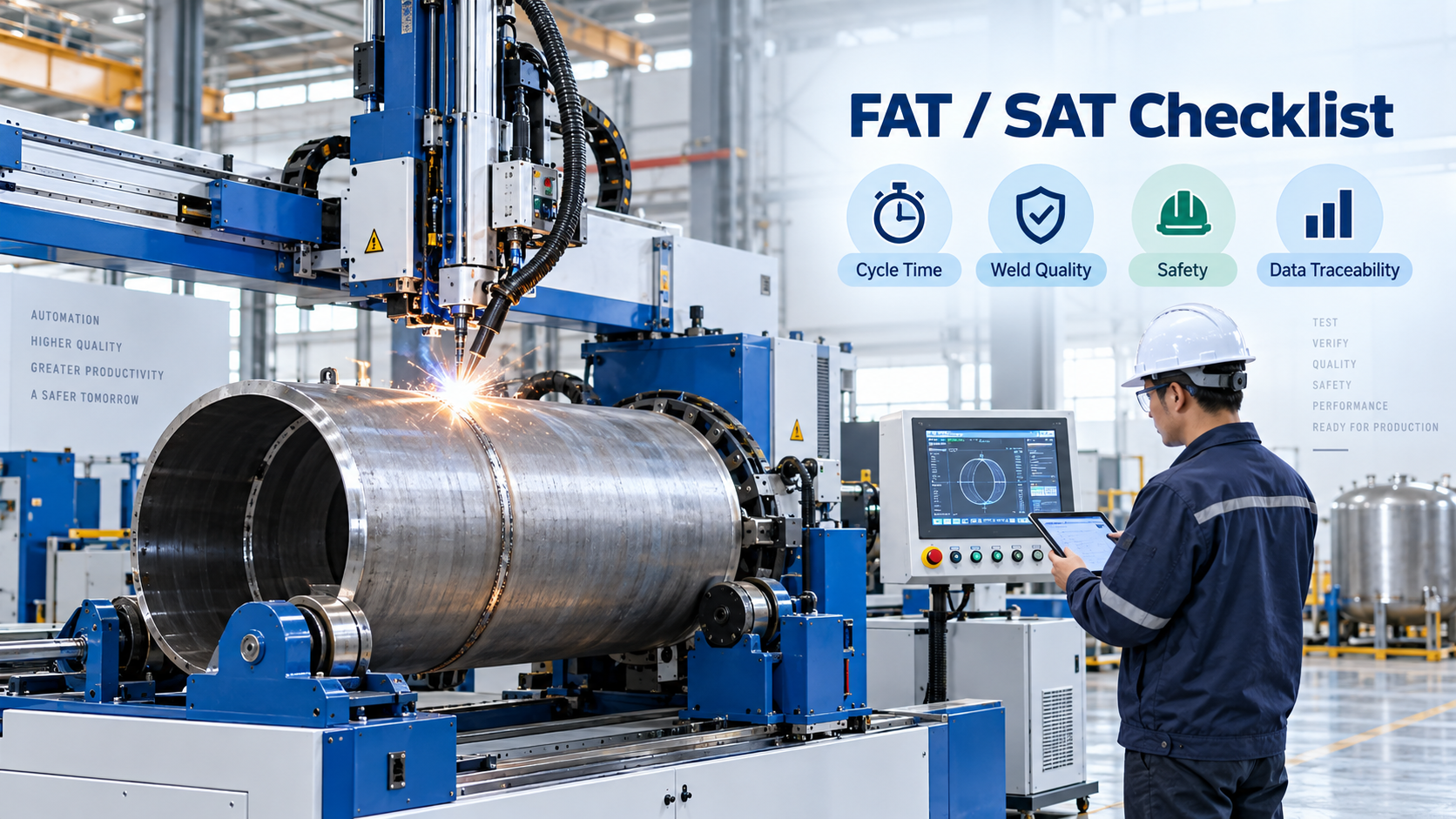
For many factories, an automatic welding system is not just one machine. It is a full production cell that links fixtures, robots or motion axes, welding power sources, sensors, safety devices, and data systems. Therefore, before the system enters mass production, both FAT and SAT are very important.
FAT means Factory Acceptance Test. It is usually done at the supplier’s site before shipment. SAT means Site Acceptance Test. It is done after the equipment is installed at the customer’s plant. Together, automatic welding machine FAT SAT checks help confirm that the system is stable, safe, and ready for real production.
As a custom welding machine manufacturer and welding system integrator China, Juchuang focuses on practical welding automation solutions for industrial production. A clear checklist helps both the buyer and supplier avoid unclear standards, reduce rework, and speed up final approval.
Why FAT and SAT Matter in Welding Automation
Automatic welding has many benefits. It can improve output, reduce manual skill gaps, and make weld quality more consistent. However, these benefits only appear when the system is tested against clear welding automation acceptance criteria.
Without a checklist, teams may only check whether the machine “can weld.” That is not enough. A good acceptance process should also check cycle time, weld appearance, penetration, safety logic, alarm response, fixture repeatability, and welding data traceability.
In short, FAT proves the system is built correctly. SAT proves the system works correctly in the real factory environment.
1. Cycle Time Checklist
Cycle time is one of the first items to confirm because it directly affects production capacity. During FAT, the supplier should test the machine with agreed sample parts, fixtures, and welding programs.
Key points include:
- Loading and unloading time
- Clamping and positioning time
- Arc-on welding time
- Robot or axis movement time
- Cooling or waiting time
- Total cycle time per part
- Output per hour or per shift
Also, the test should be repeated several times. One good result is not enough. For example, the system should run a continuous trial to show that the cycle time is stable.
During SAT, the same test should be done again with real operators, real plant utilities, and actual production flow. If the site air pressure, power supply, or part tolerance is different, the final cycle time may change. Therefore, FAT and SAT should both record the test conditions.
2. Weld Quality Checklist
Weld quality is the core of any welding automation project. Even if the cycle time is fast, the system is not acceptable if the weld is unstable.
The checklist should include both visual and technical checks. Common items include:
- Weld bead size and shape
- Weld start and stop points
- Spatter level
- Undercut, overlap, pores, cracks, or burn-through
- Weld penetration
- Weld strength test, if required
- Part distortion after welding
- Repeatability across multiple parts
In many projects, the customer provides drawings, weld symbols, samples, or inspection standards. These documents should become part of the welding automation acceptance criteria.
In addition, the team should test parts from different batches if possible. This helps confirm that the system can handle normal part variation. If the parts vary too much, the fixture, sensor, or welding process may need adjustment.
3. Fixture and Positioning Checklist
A welding automation system depends heavily on accurate positioning. So, the fixture must hold the part firmly and repeatably.
The checklist should cover:
- Fixture locating accuracy
- Clamp force and stability
- Ease of loading and unloading
- Anti-mistake design
- Clearance for welding torch movement
- Access for maintenance
- Wear parts and replacement method
- Operator ergonomics
Moreover, the fixture should not damage the part surface. It should also allow fast changeover if the machine is designed for multiple models.
For custom projects, this step is especially important. A custom welding machine manufacturer should design the fixture around the customer’s part shape, welding path, production volume, and quality goals.
4. Safety Checklist
Safety must be checked before any production approval. Automatic welding systems may include moving axes, robots, high current, arc light, hot parts, fumes, and compressed air. As a result, every safety function should be tested during FAT and SAT.
Important checks include:
- Emergency stop buttons
- Safety doors and interlocks
- Light curtains or safety scanners
- Robot safety zones
- Welding arc protection
- Fume extraction connection
- Warning lights and alarms
- Safe recovery after a fault
- Clear safety labels
- Operator access control
Also, the team should test what happens when a door opens, air pressure drops, or the emergency stop is pressed. The machine should stop in a safe way. Then, it should only restart through the correct reset process.
5. Welding Data Traceability Checklist
Modern factories need more than good welds. They also need records. Welding data traceability helps quality teams review production history, find root causes, and meet customer audit needs.
The system may record:
- Part ID or batch number
- Welding program number
- Operator ID
- Welding current and voltage
- Wire feed speed
- Welding time
- Alarm history
- Pass/fail result
- Date and time
- Production quantity
Furthermore, data should be easy to export or connect to the customer’s MES or factory system when required. During FAT and SAT, the team should confirm that the data is accurate, complete, and linked to the correct part.
6. Final Acceptance Documents
A complete automatic welding machine FAT SAT process should end with clear documents. These records protect both sides and make future service easier.
Typical documents include:
- FAT report
- SAT report
- Cycle time report
- Weld inspection report
- Safety test report
- Electrical drawings
- Pneumatic drawings
- Operation manual
- Maintenance guide
- Spare parts list
- Welding parameters
- Training record
After both teams sign the report, the system can move into formal production.
Conclusion
A strong FAT/SAT checklist helps factories buy and launch welding automation with less risk. It turns unclear expectations into clear test items. More importantly, it confirms that cycle time, weld quality, safety, and data traceability meet real production needs.
For companies looking for a custom welding machine manufacturer or welding system integrator China, Juchuang can support automatic welding projects from process design and fixture development to machine building, testing, installation, and service.


