Differences between Plasma and TIG Welding for Tank Fabrication
News Details
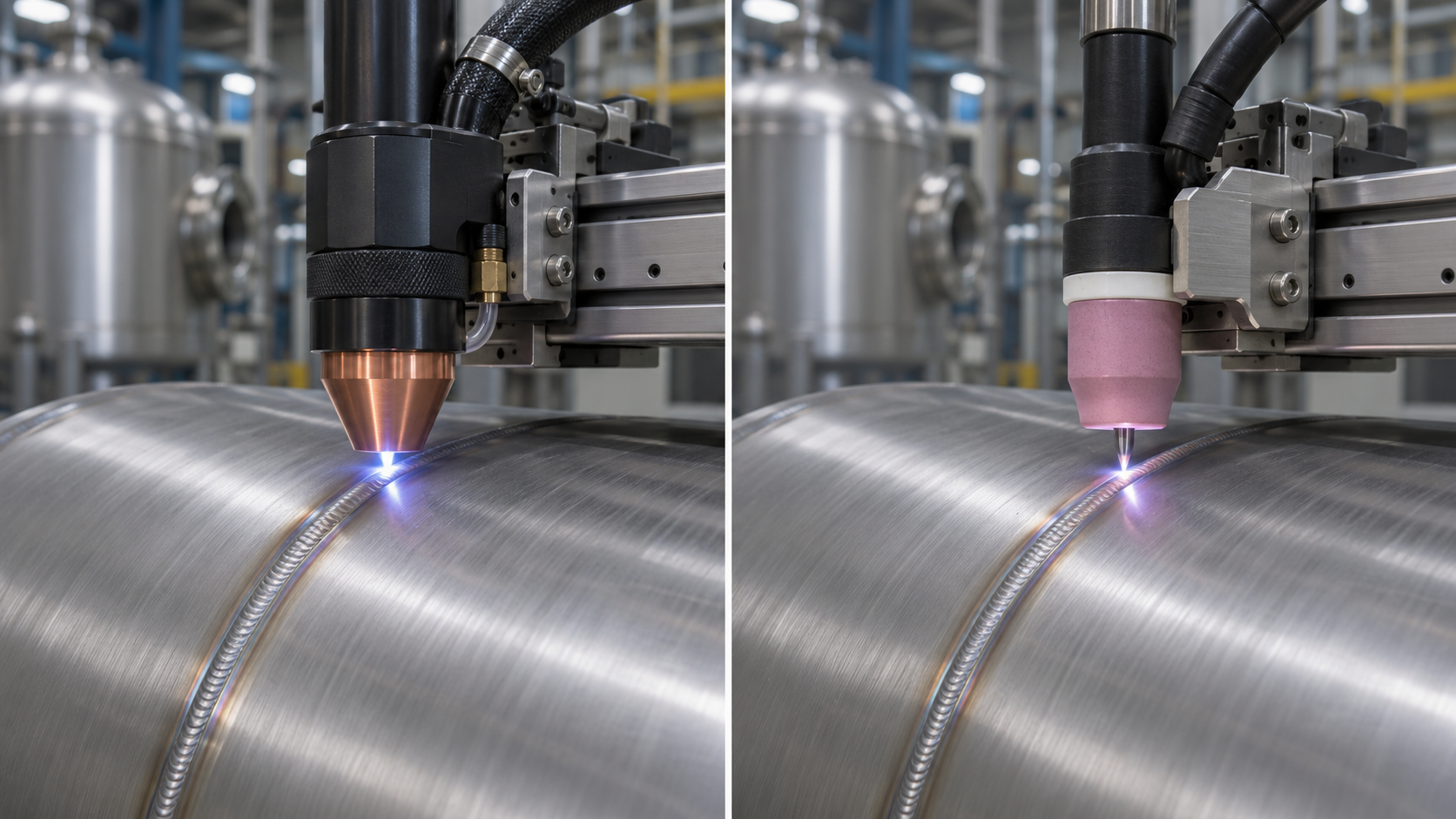
A rolled vessel shell has a straight joint where the two plate edges meet. A fabricator can weld that joint with either plasma or TIG. The choice depends on what takes time in the shop. If a repeat seam needs several passes to reach full penetration, keyhole plasma welding is worth a trial. If an existing TIG procedure already makes an accepted seam in one pass, automating torch travel may offer more value than changing the process.
What is the difference between plasma and TIG welding?
Tungsten inert gas (TIG) welding uses an arc between a tungsten electrode and the workpiece. The arc melts the joint edges, while shielding gas protects the molten metal. The process can use filler wire when the joint calls for it. In automated TIG welding, a machine guides the torch along the seam or turns the vessel beneath it.
Plasma arc welding (PAW) also uses a tungsten electrode. The main difference is the torch. A PAW welding system directs gas through a small copper nozzle that narrows the arc and concentrates its heat. In keyhole mode, the arc opens a small hole through the joint. As the torch moves forward, molten metal flows behind the hole and closes it. On a suitable joint, this can produce a full-penetration weld in one pass.
When does a PAW welding system make sense?
Consider a shop that makes the same stainless steel shell each week. Its TIG procedure needs more than one pass along each long seam. If a plasma trial produces an acceptable weld in one pass, the shop saves a full trip along the shell each time it removes a pass. That saving grows with seam length and order volume.
The key question is whether the result holds across a normal batch. Plate thickness alone cannot settle the choice. The joint gap, edge alignment, travel speed, and plasma gas flow all affect the weld. Test shells from your own rolling process, including parts near the limits of your fit-up tolerance. For a circular seam, also inspect the point where the weld ends. The system must close the keyhole cleanly as it completes the circle.
When is automated TIG welding the better fit?
Automated TIG welding is a practical starting point when the shop already has a TIG procedure that produces the required root profile. The root is the underside of the weld, often on the inside of the shell. If that surface is hard to reach after assembly, include its shape and finish in the equipment trial.
Take a thin shell that already passes inspection after one TIG pass. Plasma has no extra pass to remove on this job. Instead, measure how much time the operator spends aligning the edges, setting the torch, and loading the next shell. Better clamping or repeatable torch travel may shorten the batch cycle while preserving the weld profile the customer accepts.
Can plasma and TIG work on the same vessel seam?
Yes. Juchuang’s fixed longitudinal seam welding machine combines plasma and TIG for straight joints on cylindrical shells, cones, and flat plate. It is designed to weld from one side while forming a bead on the reverse side. For a vessel buyer, that makes the inside bead a useful point to inspect during a demonstration. Explore Juchuang’s fixed longitudinal seam welding machine.
How should buyers compare plasma vs TIG welding in a trial?
Give each supplier the same material grade, shell drawing, wall thickness range, and acceptance criteria. Then compare four results.
| Trial measure | What to record |
|---|---|
| Fit-up time | Minutes spent aligning, clamping, and tacking the joint before welding |
| Full cycle time | Time from loading the shell to unloading it, including every weld pass |
| Weld quality | Root profile, distortion after unclamping, and results of the required inspections |
| Cost per accepted seam | Total batch cost, including labor, gas, wire, consumables, and rework, divided by the number of accepted seams |
For a pressure vessel, agree with your welding engineer on the procedure qualification and inspection requirements that apply to the job. Then use the trial to answer the buying question. Does plasma cut enough passes to lower the cost per accepted vessel, or does automated TIG already deliver the required weld at your target output?


