PAW vs TIG vs MIG/MAG for Automated Seam Welding
News Details
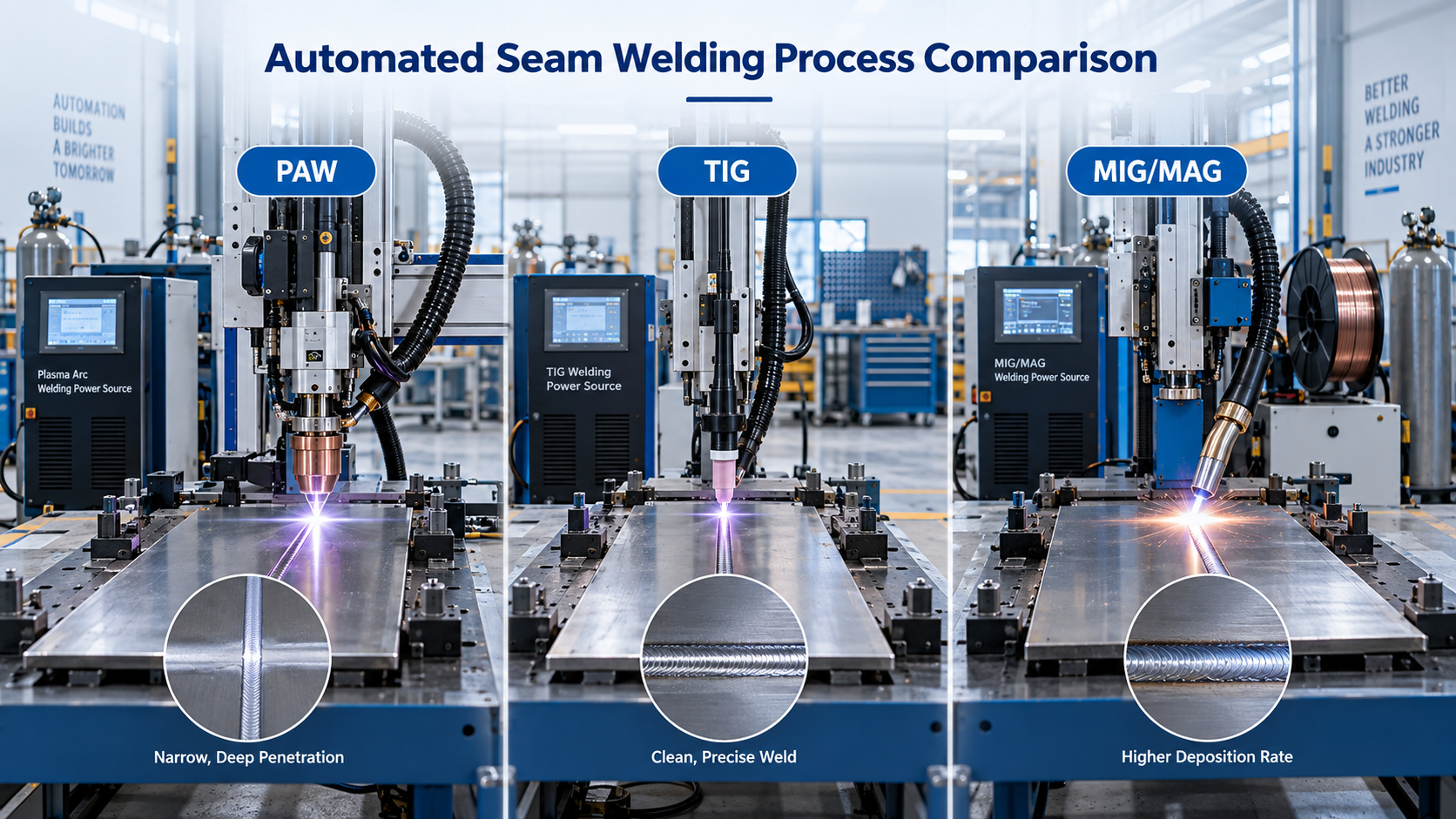
Automatic longitudinal seam welding is widely used in tanks, pipes, pressure vessels, stainless steel products and metal shells. It helps factories improve welding quality, reduce manual labor and maintain stable production.
However, the welding process plays a decisive role. PAW, TIG and MIG/MAG can all be used for seam welding, but they are not the same. Each process has its own advantages, limitations and most suitable application scenarios.
Juchuang provides customized welding automation system solutions for pressure vessels, tanks, pipes and other industrial parts. Its equipment range includes longitudinal seam welding machines, side beam welding systems, welding manipulators, and automated systems that can integrate PAW, TIG, MIG/MAG or a combination of processes.
What is PAW welding?
PAW stands for Plasma Arc Welding. It utilizes a focused plasma arc to generate concentrated, stable heat. Thanks to the narrow, high-energy arc, PAW is commonly used in applications requiring high precision and excellent penetration.
For automatic longitudinal seam welding, PAW is an ideal choice for stainless steel tanks, pressure vessels and thin-to-medium wall components. In many cases, it enables one-side welding with back formation, which minimizes extra work on the reverse side of the seam.
In addition, PAW offers stable performance in automated production when workpiece fit-up is precisely controlled. However, it requires careful setup. Torch height, gas flow, current and seam alignment must all be accurately calibrated.
What is TIG welding?
TIG welding, also known as Gas Tungsten Arc Welding (GTAW), uses a tungsten electrode and shielding gas. It is known for clean welds, smooth appearance and precise control. An automatic TIG welding machine is often used for stainless steel, aluminum and other materials where weld quality and finish are critical.
TIG welding can be performed with or without filler wire. When wire feeding is incorporated, it enhances weld buildup and helps fill the joint effectively.
Compared to MIG/MAG, TIG welding is usually slower. Nevertheless, it delivers high weld quality and minimal spatter. Therefore, it is commonly utilized for tanks, pipes, thin plates, food equipment, chemical equipment and products with strict surface requirements.
What is MIG/MAG welding?
MIG/MAG welding uses a continuously fed wire electrode. MIG utilizes inert gas, whereas MAG employs active gas. Many factories choose automatic MIG MAG welding due to its high welding speed and deposition rate.
This process is ideal for carbon steel, stainless steel, structural components, tanks and medium-to-thick plates. It is also well suited for production lines requiring high output.
However, MIG/MAG may produce more spatter than TIG or PAW. Weld appearance also depends heavily on parameter settings, gas shielding, wire quality and torch positioning. Thus, a stable machine and robust process control are essential.
PAW vs TIG Welding: Key Differences
When comparing PAW and TIG welding, the primary distinction lies in arc concentration.
PAW features a more highly concentrated arc, resulting in deeper penetration and higher energy density. This makes it suitable for longitudinal seam welding where consistent root formation is essential.
TIG, in contrast, has a softer arc and produces exceptionally clean weld appearance. It is easier to apply in many precision welding tasks, particularly for thin components and visible welds.
Simply put, PAW is often preferred for penetration and speed under controlled conditions, while TIG is chosen for precise control and clean surface finish.
TIG vs MIG/MAG in Automated Production
Both TIG and MIG/MAG are commonly used in automatic longitudinal seam welding, but they serve different purposes.
TIG is preferable when weld appearance, low spatter and heat control are key requirements. It is often applied to stainless steel tanks, thin shells and high-quality visible weld seams.
MIG/MAG is more suitable when speed and filling capacity are prioritized. It achieves faster welding speeds and deposits more metal into the joint, making it ideal for thicker components or high-volume production.
Still, the optimal choice depends on the specific product. A tank seam welder, side beam welding system or welding manipulator may utilize different processes based on material type, thickness, joint design and inspection standards.
How to Select the Appropriate Process
Before choosing between PAW, TIG or MIG/MAG, factories should evaluate their actual production requirements.
Key considerations include:
- What material will be welded?
- What is the wall thickness?
- Is the seam longitudinal, circumferential, or both?
- Is one-side welding with back formation required?
- Is weld appearance a critical factor?
- What welding speed is needed?
- Is filler wire required?
- What inspection standards must be met?
- How well controlled is the workpiece fit-up?
- Will the system require data recording or seam tracking?
For thin stainless steel components with high surface finish requirements, TIG may be the optimal choice. For precision longitudinal seam welding with deeper penetration, PAW offers superior performance. For higher speed and thicker workpieces, MIG/MAG may be more practical.
How Automation Improves Welding Results
Manual welding heavily relies on operator skill. In contrast, automatic longitudinal seam welding controls torch travel, welding speed, arc length, wire feed and repeated positioning. This significantly enhances process consistency.
However, automation alone cannot solve every issue. High-quality results still require accurate fixturing, clean workpiece edges, correct parameter settings and proper testing. That is why process trials are essential before final machine delivery.
Juchuang can design custom welding systems based on the customer’s workpiece, factory layout and process objectives. This includes machine structure, torch movement, clamping fixtures, welding power sources, control systems and acceptance testing.
When Combined Processes Are Beneficial
In certain projects, a single welding process may not be sufficient. For example, PAW can be used for root penetration, while TIG enhances surface finish. In other cases, TIG with wire feeding balances quality and productivity.
Combined systems can be advantageous for pressure vessels, stainless steel tanks and specialized industrial products. However, they also demand more precise control and meticulous setup. Therefore, the process should be selected based on actual welding tests rather than theory alone.
Conclusion
PAW, TIG and MIG/MAG each play a vital role in automatic longitudinal seam welding. PAW excels in concentrated heat and deep penetration. TIG is known for clean, precise welds. MIG/MAG is valued for its speed and high deposition rate.
For factories deciding between an automatic TIG welding machine, automatic MIG MAG welding, or a PAW-based system, the best choice depends on material, thickness, seam type, quality requirements and production volume. With proper design and testing, automatic longitudinal seam welding can achieve faster, cleaner and more consistent results.


