
In industrial piping networks, connecting a straight pipe to a flat flange is a very common task. These joints are critical because they must withstand intense fluid pressure, extreme temperature shifts, and chemical corrosion without leaking. For many years, workshops relied purely on manual labor to join these parts. However, manual work often slows down production and leads to inconsistent weld quality.
If you manage a modern fabrication facility, you might ask: what type of welding is actually used for pipe to flange joints? In this popular science blog, we will explore the best methods for this job and explain how modern industrial welding systems can help your factory run faster.
 |
 |
The Primary Methods for Pipe to Flange Connections
Depending on the thickness of the metal, the type of material, and the pressure rules of the project, engineers generally choose between a few core processes:
TIG Welding (Gas Tungsten Arc Welding)
TIG welding is highly favored for high-purity pipelines, stainless steel materials, and thin-walled pipes. It uses a non-consumable tungsten electrode to create a highly clean, precise arc. This process gives the operator complete control over the heat, producing beautiful, defect-free joints that easily pass strict non-destructive testing (NDT). However, manual TIG work is often quite slow.
MIG/MAG Welding (Gas Metal Arc Welding)
For high-volume production and thicker carbon steel components, MIG/MAG welding is the preferred option. This method utilizes a continuously fed wire electrode that acts as both the heat source and the filler metal. Because it deposits metal rapidly, it cuts down total assembly times on the shop floor.
Plasma Arc Welding (PAW)
Plasma technology is an advanced option for heavy-duty industrial applications. It uses a highly constricted, deeply concentrated plasma arc to melt the metal joint. This process allows for extremely fast speeds, deep seam penetration, and minimal thermal warping across the workpiece.
Upgrading the Process with a Dedicated Welding System
No matter which specific arc process you choose, relying on manual torch handling can limit your business growth. Human workers naturally experience physical fatigue during long shifts, which can lead to uneven travel speeds and wrong torch angles.
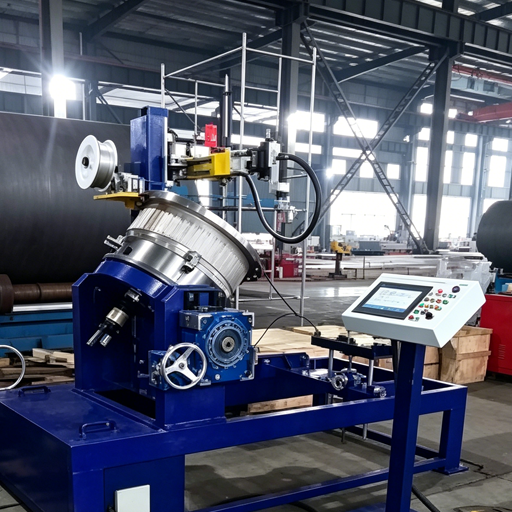
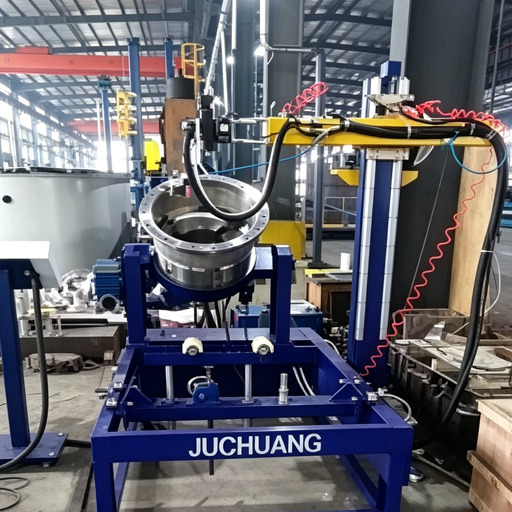
To overcome these human errors, factories are upgrading to an integrated welding system. A dedicated pipe-to-flange setup secures the pipe and flange in place using heavy-duty pneumatic clamps. Then, a mechanized system rotates the entire assembly at a perfectly steady speed while the torch applies a clean, uniform bead around the circular joint.
Scaling Output with Automated Robotic Welding Systems
For manufacturing facilities that handle massive production orders or complex piping layouts, deploying modern automated robotic welding systems provides a huge competitive edge. These smart configurations pair robust multi-axis robotic arms with intelligent vision sensors.
Instead of a worker holding the torch in awkward positions, a programmed computer guides the robotic arm along the circular seam with absolute machine precision. These systems automatically adjust their parameters in real-time, delivering identical, high-reproducibility welds line after line. This completely removes human error and cuts out the need for slow post-weld manual grinding.
The Key Benefits for Your Factory Floor
Switching from slow manual joints to automated machinery brings clear advantages to your workshop:
-
Faster Production Cycles: Automated tools do not need breaks or shift changes, allowing your factory to complete large commercial contracts well ahead of schedule.
-
Lower Operational Costs: Machine accuracy prevents over-welding, which reduces raw metal waste and saves money on expensive shielding gas.
-
Flawless Quality Control: Uniform heat input stops the metal from warping or bending, ensuring your pipe assemblies easily clear strict pressure and leak tests.
Conclusion: Partner with Juchuang to Standardize Your Line
Ultimately, boosting your factory output requires moving away from manual dependencies and investing in rigid, smart, and fully adjustable machinery. By using a system that provides robust joint tracking and smart process monitoring, you can eliminate weld flaws and maximize daily shop floor output.
Based in Changzhou City, Jiangsu Province, Juchuang Automation is a trusted high-tech developer of premium industrial machinery. Deeply rooted in the automation industry for over a decade, our engineering team operates under a simple, strict business rule: "Technology as the Root, Quality as the Foundation."
We serve global B2B clients in the energy, chemical processing, pressure vessel, and construction machinery fields. Because standard catalog machines do not fit every unique factory floor layout, our team specializes in specialized, non-standard customized designs. Whether you need an automatic tube-to-tube sheet system, a dedicated tube-to-flange welder, or a complete robotic work cell, we can build the perfect setup for your goals.
Stop losing time to manual fixes and local welder shortages. Contact our international trade department today to talk about your goals, receive a technical configuration review, or request a detailed engineering plan for your shop.
-
Company Name: Jiangsu Juchuang Automation Technology Co., Ltd.
-
Official Website:https://www.jcweldtech.com/
-
Corporate Email: juchung@sina.com
-
Contact Number / WhatsApp: +86-189-1583-5369


