
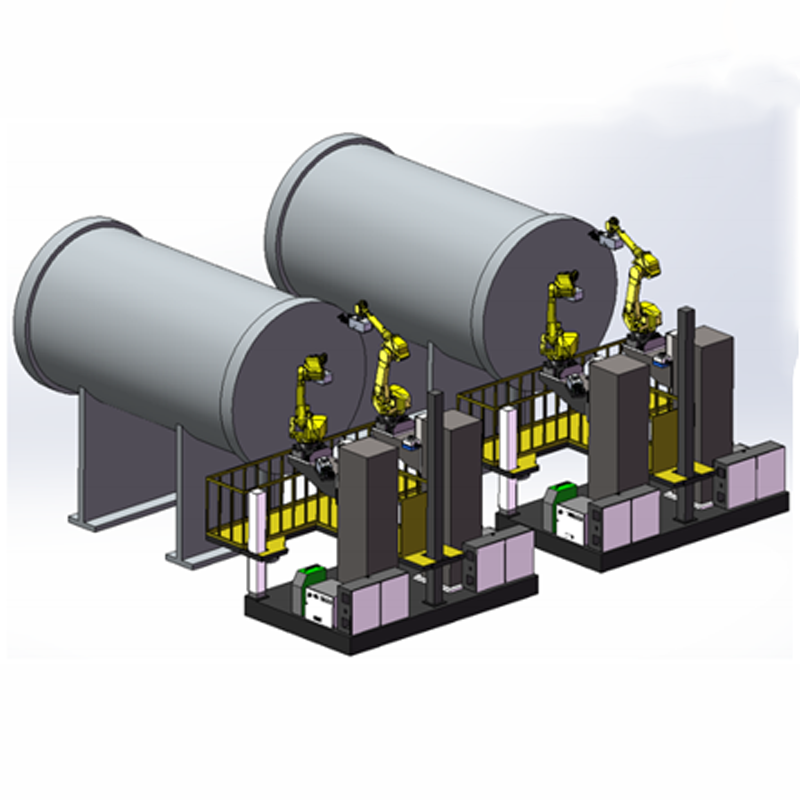
The global manufacturing industry is changing at a very rapid pace. Today, industrial factories face tough challenges like rising labor costs, a shrinking pool of experienced welders, and tight production deadlines. Because of these pressures, traditional manual welding is no longer enough to keep up with market demands. To stay competitive, forward-thinking businesses are turning to automated machinery. Specifically, implementing a modern robotic welding system has become the gold standard for achieving high efficiency and flawless product quality.
But what exactly is this technology, and how does it function on the factory floor? Let us break down the fundamentals of this advanced industrial solution.
Understanding the Basics of Robotic Welding Systems
At its core, a robotic welding system is a fully automated workstation designed to perform welding tasks without relying on constant human manual labor. It combines mechanical engineering, computer software, and advanced welding technology into a single cohesive unit.
Instead of a human operator holding a heavy torch and working in a smoky environment, an industrial robot arm manipulates the torch along a precise digital path. Meanwhile, the human operator steps into a safer role, acting as a programmer and system supervisor who monitors the machinery from a digital control panel.
These advanced workstations can handle multiple manufacturing disciplines. Depending on your factory needs, they can be configured for Metal Active Gas (MAG) welding, Tungsten Inert Gas (TIG) welding, or Plasma Arc Welding (PAW).
Core Components of a Welding Robot System
A complete, factory-ready welding robot system is much more than just a mechanical arm. It is a highly integrated network where several sub-systems interact at lightning-fast speeds. The main components include:
- The Manipulator (The Robot Arm): This is the physical arm that moves the welding torch. Most modern systems use a 6-axis arm, which allows the torch to tilt, twist, and reach into tight corners just like a human wrist, but with far greater stability.
- The Controller: This functions as the central brain of the entire system. It stores the programming data, processes inputs from sensors, and sends real-time movement commands to the robot arm.
- The Welding Power Supply and Torch: This sub-system generates the electrical arc needed to melt the metal. The torch is specifically ruggedized to handle non-stop industrial cycles without overheating.
- The Wire Feeder: For processes that require filler metal, an automated feeder pushes the welding wire smoothly through the torch assembly. Premium designs use a tangle-free setup to prevent production stops.
- Tooling and Workholding Fixtures: These specialized clamps hold the raw metal parts securely in place, ensuring that every single workpiece sits in the exact same position before the robot begins its work.
Key Benefits of Industrial Welding Automation
Upgrading to robotic welding systems offers massive commercial advantages for B2B manufacturers:
1. Unmatched Quality and Consistency
Human welders, no matter how skilled, get tired after hours of repetitive work, which can lead to minor variations in the weld bead. In contrast, a robot never experiences fatigue. It maintains the exact same travel speed, torch angle, and arc length from the first minute of the shift to the last, yielding identical, high-reproducibility results every single time.
2. Drastic Cycle Time Reduction
Robotic systems move much faster than human operators. They can transit between different weld seams rapidly, and they do not need to pause for breaks. This continuous operation allows factories to double or even triple their daily part output.
3. Safer Work Environments
Welding exposes workers to intense heat, blinding arc flashes, and toxic metal fumes. By moving the human operator away from the immediate arc zone and behind a protective safety enclosure, factories dramatically reduce workplace injuries and liability costs.
Intelligent Tracking: Making Robots Smarter
In real-world manufacturing, metal parts are not always 100% perfect. Minor metal warpage or small errors during part loading can cause the actual weld seam to shift slightly from the original digital program.
To solve this issue, modern systems incorporate smart tracking software. For instance, Laser Vision Seam Tracking uses a precise laser sensor mounted just ahead of the torch to scan the joint in real time. If it detects a deviation, it instantly tells the controller to adjust the robot arm's path, keeping the torch perfectly centered on the seam.
Juchuang’s Proven Automation Solutions: A Client Success Story
To see a robotic welding system in action, let us look at a real-world industrial solution engineered by Jiangsu Juchuang Automation Technology Co., Ltd.
A prominent industrial automation integrator in South Korea needed an efficient automated workstation to manufacture cooling liquid flow monitoring components. The project required high-volume production with zero defects. However, their existing manual welding setup was far too slow, suffered from high reject rates, and created a severe bottleneck on their production line.
Juchuang carefully evaluated the client's material specifications, joint geometries, and factory floor space. To solve their problem, we designed and integrated a custom welding robot system featuring a high-accuracy multi-axis arm, a specialized program control unit, and quick-change pneumatic fixtures.
The Project Outcomes:
- Significant Cost Reduction: By replacing slow manual tasks with Juchuang's continuous automated workstation, the factory successfully lowered its overall maintenance and operational costs.
- Flawless Quality and High Precision: The smooth, vibration-free movement paths of the integrated arm eliminated human error entirely, producing beautiful, high-reproducibility welds that cleared all quality inspections.
- Massive Production Scale-Up: The automated workstation allowed the manufacturer to complete and deliver a high-volume batch of 1,200 units to their end-users well ahead of schedule.
Conclusion: Take the Next Step in Automation
To sum up, a robotic welding system is an invaluable asset for any modern industrial factory looking to overcome labor shortages, eliminate scrap metal, and boost daily output. By combining heavy-duty mechanical arms with intelligent software and robust power sources, these systems turn complex fabrication tasks into simple, highly profitable automated workflows.
Operating from its state-of-the-art manufacturing headquarters in Changzhou City, Jiangsu Province, Juchuang Automation is a certified high-tech enterprise. Guided by our business philosophy, "Technology as the Root, Quality as the Foundation," we specialize in designing non-standard, custom automated machinery for global B2B clients in the energy, chemical, pressure vessel, and construction machinery sectors.
Whether you need a compact CNC tube sheet welding station, a heavy-duty side beam tank line, or a highly flexible robotic cell, our engineering team can build the perfect system for your workshop. Contact our international trade department today to discuss your production goals and receive a detailed technical proposal.
- Company Name: Jiangsu Juchuang Automation Technology Co., Ltd.
- Official Website:https://www.jcweldtech.com/
- Corporate Email: JCKJWELD@SINA.COM
- Contact Number / WhatsApp: +86-189-1583-5369


