
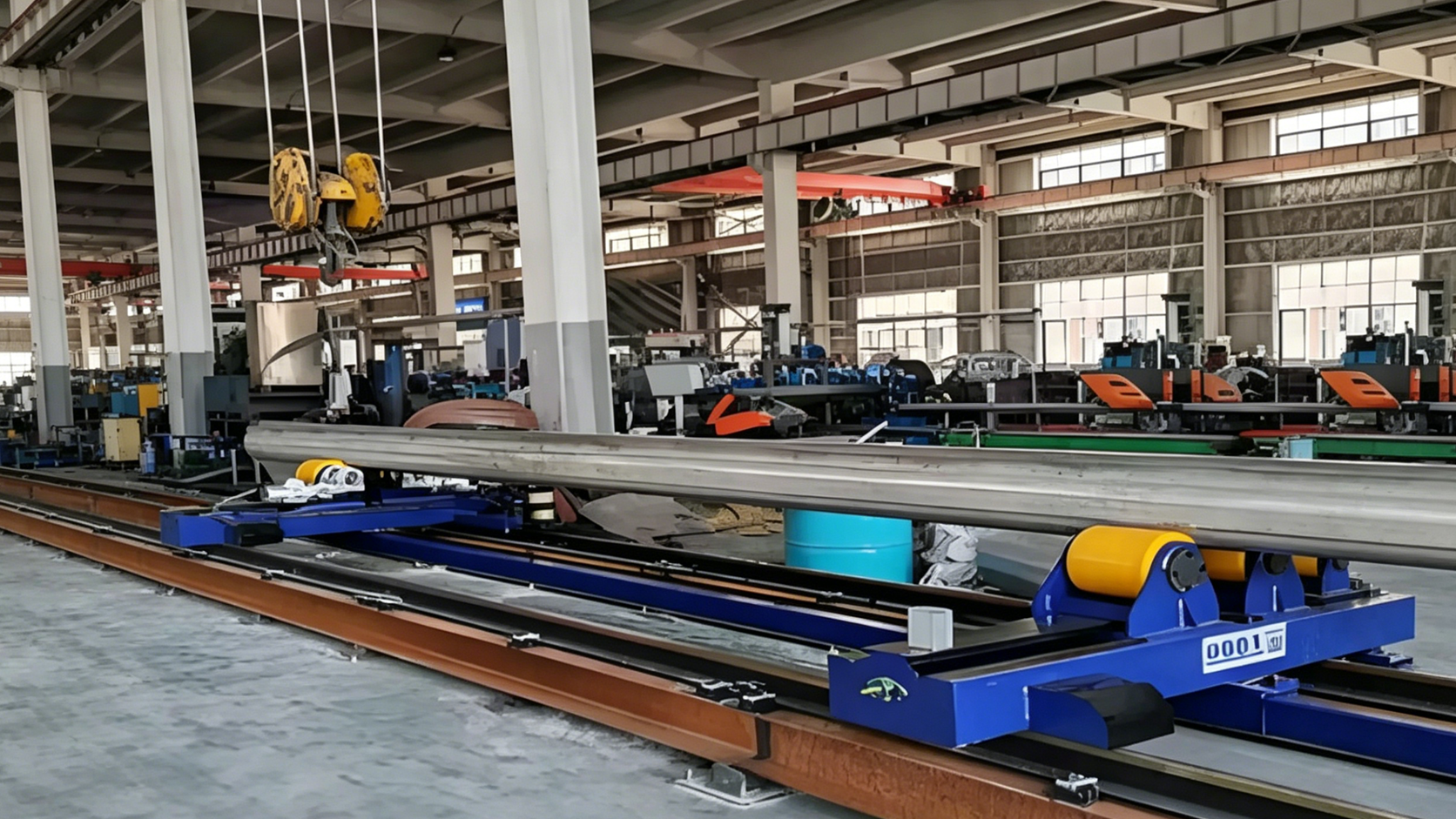
Industrial manufacturing is changing very fast. Today, global factories face rising labor costs, a shortage of skilled welding operators, and strict quality demands. Because of these challenges, investing in an automatic welding system is no longer just an option. Instead, it has become a necessary step to stay competitive in the B2B marketplace.
However, choosing the right automated welding machinery can feel overwhelming. A wrong decision can lead to high equipment expenses, compatibility issues, and production delays. Therefore, managers must understand exactly what to look for when evaluating automatic welding systems for their workshops.
1. Analyze Your Product Materials and Wall Thickness
First and foremost, your choice of an automatic welding system depends entirely on the metals you use. Different materials react differently to heat, which dictates the specific welding process you need.
-
Carbon Steel and Stainless Steel: These are the most common industrial materials. They work exceptionally well with standard Metal Active Gas (MAG), Tungsten Inert Gas (TIG), or Submerged Arc Welding (SAW) systems.
-
Titanium and Nickel Alloys: These metals are highly sensitive to atmospheric contamination. Consequently, they require premium gas shielding and precise heat control. For instance, high-tech sectors like aerospace and chemical processing rely heavily on automated TIG or Plasma Arc Welding (PAW) setups to protect weld integrity.
In addition to the metal type, you must measure the wall thickness of your workpieces. If you fabricate thin-walled tubes between 1mm and 6mm, a high-reproducibility orbital TIG system is ideal. On the other hand, if your facility fabricates heavy-wall pressure vessels between 3mm and 20mm, you should look for advanced systems that offer filler-wire capabilities and automatic arc oscillation to handle multi-pass joints.
2. Evaluate Workpiece Geometry and Joint Types
Next, take a close look at the shape of your products. Workpiece geometry determines whether you need a dedicated, fixed CNC machine or a highly flexible robotic welding arm.
Pipe-to-Pipe Butt Welding
If your factory mainly connects straight pipelines, industrial elbows, or pipe tees, you need a specialized orbital welding head. In these scenarios, look for a torch design that offers an integrated, tangle-free wire feeder. This feature ensures that the torch can spin infinitely around the pipe without wrapping cables, resulting in consistent full-position joints.
Tube-to-Tube Sheet Joints
For heat exchangers, boilers, and condensers, your biggest challenge is welding hundreds of tightly packed tube ends onto a single plate. For this specific task, you need an automated tube sheet welding head. The system should support multiple assembly forms, such as when tubes protrude, sit flush, or retract into the sheet.
Large Cylinders and Tanks
If you build massive chemical storage tanks, a small torch head will not suffice. Instead, your shop floor requires a heavy-duty side beam welding fixture integrated with motorized turning rolls. This setup allows the welding head to travel smoothly along a rigid beam while the rolls rotate the massive vessel, executing flawless external longitudinal and circumferential seams.
3. Look for Smart Control and Tracking Features
A truly efficient automatic welding system must include smart tracking technologies. Without these automated features, your operators will spend too much time stopping the machine to make manual adjustments.
-
3D Laser Vision Positioning: Before the arc ignites, a 3D cross-laser system scans the joint area. It automatically identifies the exact seam location, which eliminates minor human errors during loading.
-
Closed-Loop Arc Voltage Tracking (AVC): During the active welding process, the distance between the tungsten electrode and the metal surface can vary due to minor plate warpage. AVC technology tracks the weld in real time, automatically raising or lowering the torch to keep the voltage perfectly stable.
-
Wire and Consumable Alarms: To keep production moving safely, look for a system that includes its own automated reminders. For example, if the machine detects that the filler wire is running out or that a tungsten electrode has reached its service life limit, it should automatically stop, move to a safe position, and emit an audible alarm.
4. Consider Factory Space and System Integration
Before signing a commercial contract, you must consider how the new equipment fits into your layout. Do you want a compact, self-contained workstation, or do you need a large, modular line?
A complete, factory-ready system should integrate multiple subsystems into one collaborative network. For instance, the industrial computer, programmable logic controller (PLC), robotic arm, and welding power supply must interact at high speeds through reliable communication protocols like TCP/IP bus.
Furthermore, ensure the welding power source uses a high-duty cycle core. A high duty cycle ensures that the machine can weld continuously at peak amperage without overheating, which maximizes your daily shop floor output.
Juchuang’s Proven Automation Solutions: A Client Case Study
To see how these selection factors work in the real world, let us look at a practical solution engineered by Jiangsu Juchuang Automation Technology Co., Ltd.
An international medical equipment manufacturer in Europe needed an automated setup to fabricate high-purity stainless steel fluid monitoring vessels. The technical requirements were incredibly demanding. The internal weld beads had to pass strict non-destructive testing (NDT), requiring 100% flat, oxide-free surfaces to prevent bacterial growth. Additionally, manual production was far too slow to meet their growing commercial demands.
Juchuang evaluated these exact material, geometry, and space requirements. To solve the problem, we delivered a customized Side Beam Plasma P+T (Plasma plus TIG) Welding Station, paired with an automated root-shielding gas box and motorized turning rolls.
The Solution Outcomes:
-
Flawless Quality: The specialized internal back-shielding mechanism delivered a continuous blanket of argon gas, resulting in silver-white, oxide-free weld roots that cleared strict X-ray inspections on the very first try.
-
Process Compression: By utilizing the single-pass deep penetration of plasma combined with the smooth capping capability of TIG, the client completely bypassed the time-consuming multi-layer edge beveling process.
-
Massive Output Expansion: The automated system allowed the manufacturer to successfully complete and ship a batch of 500 units ahead of schedule, dramatically lowering their overall manufacturing costs.
Conclusion: Making Your Final Decision
To sum up, choosing the perfect automatic welding system requires a clear understanding of your materials, workpiece shapes, and desired level of software intelligence. By focusing on these core technical parameters, you can invest in a workstation that slashes scrap rates, increases throughput, and removes reliance on hard-to-find manual welders.
Operating from its advanced manufacturing center in Changzhou City, China, Juchuang Automation specializes in tailoring non-standard, intelligent welding equipment for the energy, chemical, pressure vessel, and engineering machinery sectors. We adhere closely to the business philosophy: "Technology as the Root, Quality as the Foundation."
Whether you need a compact CNC tube sheet welding head, an advanced robotic welding cell, or a heavy-wall industrial pipe system, our engineering team can build a custom solution for your facility. Contact our international trade department today to discuss your production goals and receive a detailed technical proposal.
Company Name: Jiangsu Juchuang Automation Technology Co., Ltd.
Official Website:https://www.jcweldtech.com/
Corporate Email: JCKJWELD@SINA.COM
Contact Number / WhatsApp: +86-189-1583-5369


